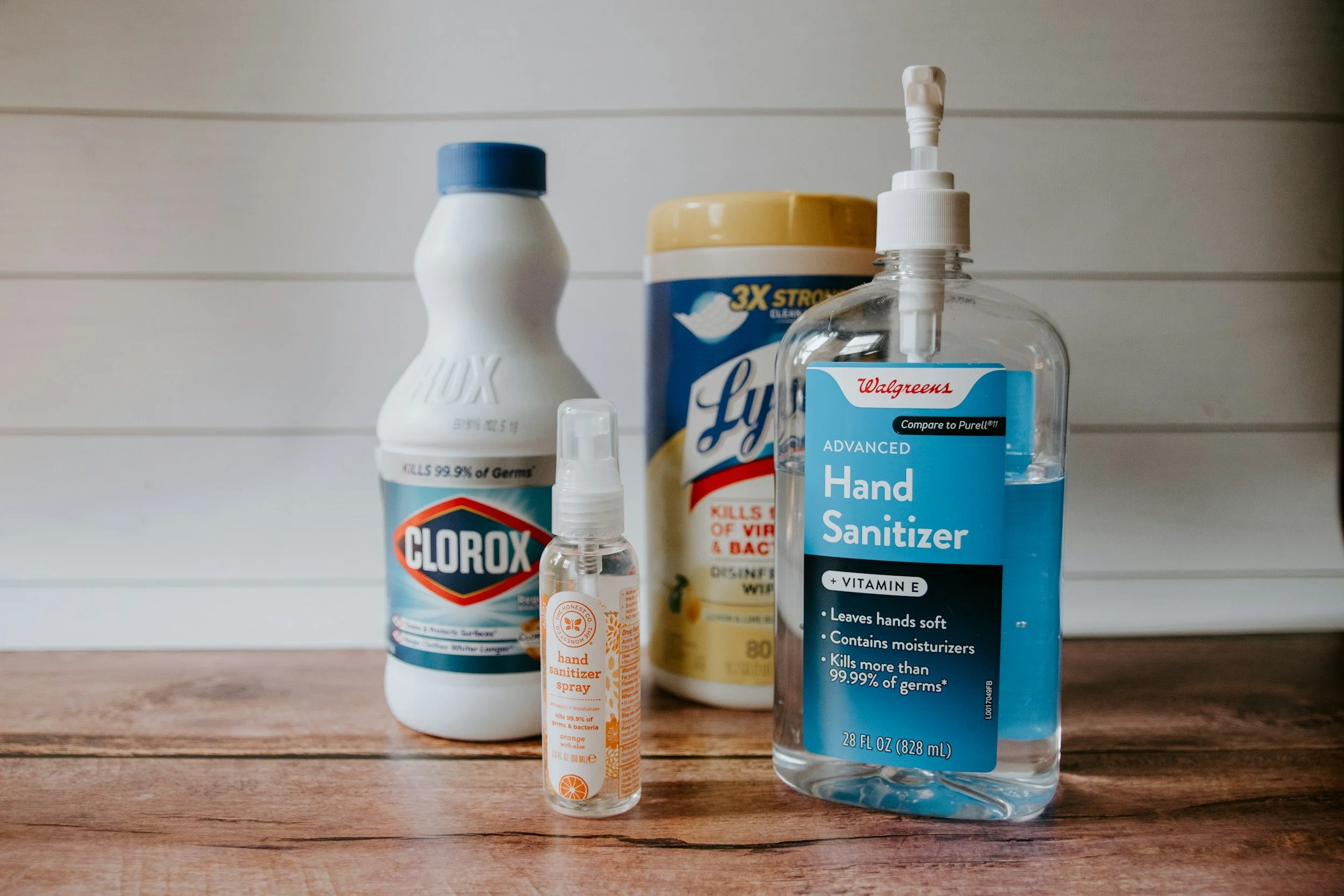
Why we use non-toxic products…
Kills 99.9% of germs" sounds like exactly what you want — but that label doesn't tell you what's happening to your skin, your air quality, or your family with repeated exposure. Here's why Rooted Home & Office Management chooses non-toxic, pH-balanced products, and when disinfectants actually make sense.
Why we use non-toxic, pH-balanced cleaning products (and what's really in "99.9% disinfectants")
That promise on the label sounds reassuring — but it doesn't tell the whole story about what those products are doing in your home.
"Do you not know that your body is a temple of the Holy Spirit within you? … So glorify God in your body." — 1 Corinthians 6:19–20
Walk down any cleaning aisle — in a grocery store, a big box retailer, anywhere — and you'll see the same promise on nearly every label: "Kills 99.9% of germs." It sounds thorough. It sounds safe. It sounds like exactly what you want when you're trying to protect your family.
But that claim doesn't tell you what chemicals are being released into your home's air, what's happening to your skin with repeated exposure, or whether that level of disinfection is actually necessary for the routine cleaning you're doing every week. At Rooted Home & Office Management, these are questions we've thought about carefully — and they're why we've made the choice to use non-toxic, pH-balanced products whenever possible.
This isn't about saying disinfectants are bad. It's about understanding what you're actually using, and making sure the products in your home are working for you — not against you.
"The right product, used the right way, at the right time. That's the standard — not the strongest chemical available."
What does "kills 99.9% of germs" actually mean?
That claim refers to laboratory tests conducted under controlled conditions against specific strains of bacteria or viruses. It is not a real-world guarantee that every pathogen in your home is eliminated — and it doesn't mean that level of chemical intervention is appropriate or necessary for everyday cleaning.
Public health guidance, including from the CDC, draws a clear distinction between two different activities that often get conflated:
Disinfecting
- Uses chemicals to kill germs on surfaces
- Appropriate for bathrooms, illness, food prep areas
- Not necessary for every surface, every time
- Increases chemical exposure with daily whole-home use
Cleaning
- Physically removes dirt, debris, and many germs
- Appropriate for most surfaces in most situations
- Gentler on skin, surfaces, and indoor air
- The right foundation for a consistently clean home
For most households, regular cleaning paired with targeted disinfection — in bathrooms, during illness, on high-touch surfaces — is the effective, balanced approach. Reaching for a disinfectant for every surface every time isn't more protective. It's just more exposure.
What's commonly found in conventional disinfectants
Many of the most widely sold cleaning sprays and wipes contain one or more of these active ingredients. Each has legitimate uses — and each carries considerations worth knowing about, especially with repeated everyday exposure.
Quaternary ammonium ("quats")
Found in most disinfecting wipes and sprays. Can leave residue on surfaces and irritate airways with repeated use.
Respiratory irritantSodium hypochlorite (bleach)
Highly effective disinfectant. Produces strong fumes; causes eye, skin, and lung irritation in enclosed spaces.
Strong irritantAlcohols (ethanol / isopropanol)
Fast-acting and quickly evaporating. Repeated contact dries and irritates skin, weakening the skin barrier over time.
Skin irritantFragrance & preservatives
"Fragrance" can represent dozens of undisclosed compounds. Associated with headaches, sensitivities, and VOC release.
Undisclosed ingredientsWorth noting
These products can absolutely be appropriate for specific situations. The concern isn't that they exist — it's that daily, whole-home use isn't always necessary, and repeated exposure adds up in ways that most product marketing never addresses.
"A prudent person foresees danger and takes precautions." — Proverbs 27:12
What frequent disinfectant use does to your skin
If you've ever spent a morning cleaning with disinfecting wipes and noticed your hands felt dry, tight, or irritated afterward — that's not coincidence. It's chemistry.
The alcohols, bleach, and surfactants in conventional disinfectants strip the skin's natural oils and disrupt its protective barrier. For people cleaning regularly — or cleaning multiple surfaces daily, as professional cleaners do — this accumulates quickly.
- Dryness and cracking from alcohols and bleach-based products
- Irritant contact dermatitis — redness, itching, and inflammation
- A weakened skin barrier that becomes increasingly sensitive to other irritants over time
- Compounding effects when the same products are used daily across a whole home
This is one of the primary reasons we prioritize pH-balanced, gentler formulations in our routine work. Protecting your home also means protecting the people doing the cleaning — including our own team.
The indoor air quality piece most people miss
Sprays, aerosols, and strongly fragranced cleaning products do more than clean surfaces — they also release compounds into the air you breathe. In a closed or poorly ventilated home, these can accumulate to levels that trigger headaches, respiratory irritation, and sensitivity reactions, particularly in children, elderly individuals, and pets.
VOCs (volatile organic compounds) released by conventional cleaners add to what researchers call the indoor chemical load — the cumulative concentration of airborne compounds in a home at any given time. Good cleaning should be removing what's in your environment. It shouldn't be contributing to it.
"Good cleaning should remove what's in your home's air — not add to it."
Why we choose non-toxic, pH-balanced products
Our product choices aren't a marketing decision — they're a values decision. We prioritize cleaning solutions that are pH-balanced, low-odor or fragrance-free when possible, low-VOC, and effective for thorough cleaning without unnecessary chemical harshness. That approach protects your surfaces, your air quality, your skin, and the people and pets in your home — without compromising on results.
- pH-balanced formulas are gentler on skin and won't degrade your home's surfaces over time
- Low-fragrance or fragrance-free products reduce VOC exposure and are safer for sensitive individuals
- Gentler everyday cleaners reduce chemical exposure for children, pets, and people with sensitivities
- Consistent, thorough cleaning delivers professional results without relying on chemical strength
When disinfectants do make sense
To be clear: we are not anti-disinfectant. There are absolutely times when targeted disinfection is the right call — and we use those products when the situation warrants it. The key word is targeted.
When we reach for disinfectants
The approach isn't "never disinfect" — it's use the right tool at the right time. That distinction matters enormously for the long-term health of your home and the people in it.
Safer everyday practices for your home
You don't have to overhaul everything to make meaningful improvements. Here are practical steps any household can take:
- Clean regularly with gentler, pH-balanced products as your everyday baseline
- Reserve stronger disinfectants for targeted, high-risk surfaces and situations
- Improve ventilation — open windows and run fans during and after cleaning
- Wear gloves for heavier or more chemical-intensive cleaning tasks
- Choose fragrance-free or low-fragrance options if you or your family have sensitivities
What a truly clean home should feel like
At Rooted Home & Office Management, we believe your home shouldn't have to rely on harsh chemicals or strong scents to feel genuinely clean. A truly clean space feels something specific — and it's not a chemical smell.
Fresh — naturally, without fragrance masking anything
Calm — no lingering chemical smell or irritation
Safe — for your family, your pets, and everyone who lives there
That's the standard we hold ourselves to on every visit, in every home we serve across Stafford, Fredericksburg, and Spotsylvania.
"Whatever you do, work at it with all your heart, as working for the Lord, not for human masters." — Colossians 3:23
Faith-based. Woman-owned. Community-focused.
At Rooted Home & Office Management, the products we use reflect the same care and intentionality as the work we do. We're committed to cleaning that is thorough, safe, and genuinely good for the families, children, and pets in every home we serve across Stafford, Fredericksburg, and Spotsylvania.
Sources & further reading
- CDC — Cleaning vs. Disinfecting Guidance
- EPA — Safer Choice Program (product safety criteria)
- NIOSH — Disinfectant exposure and health effects
- American Academy of Dermatology — Contact dermatitis and skin irritation
- Environmental Working Group (EWG) — Ingredient and product safety guides
Want your home cleaned thoroughly — without the chemical overload?
We use non-toxic, home-safe products on every visit — delivering consistent, professional results that are genuinely good for your family. Serving Stafford, Fredericksburg, and Spotsylvania.
(540) 698-5611 — call or text anytime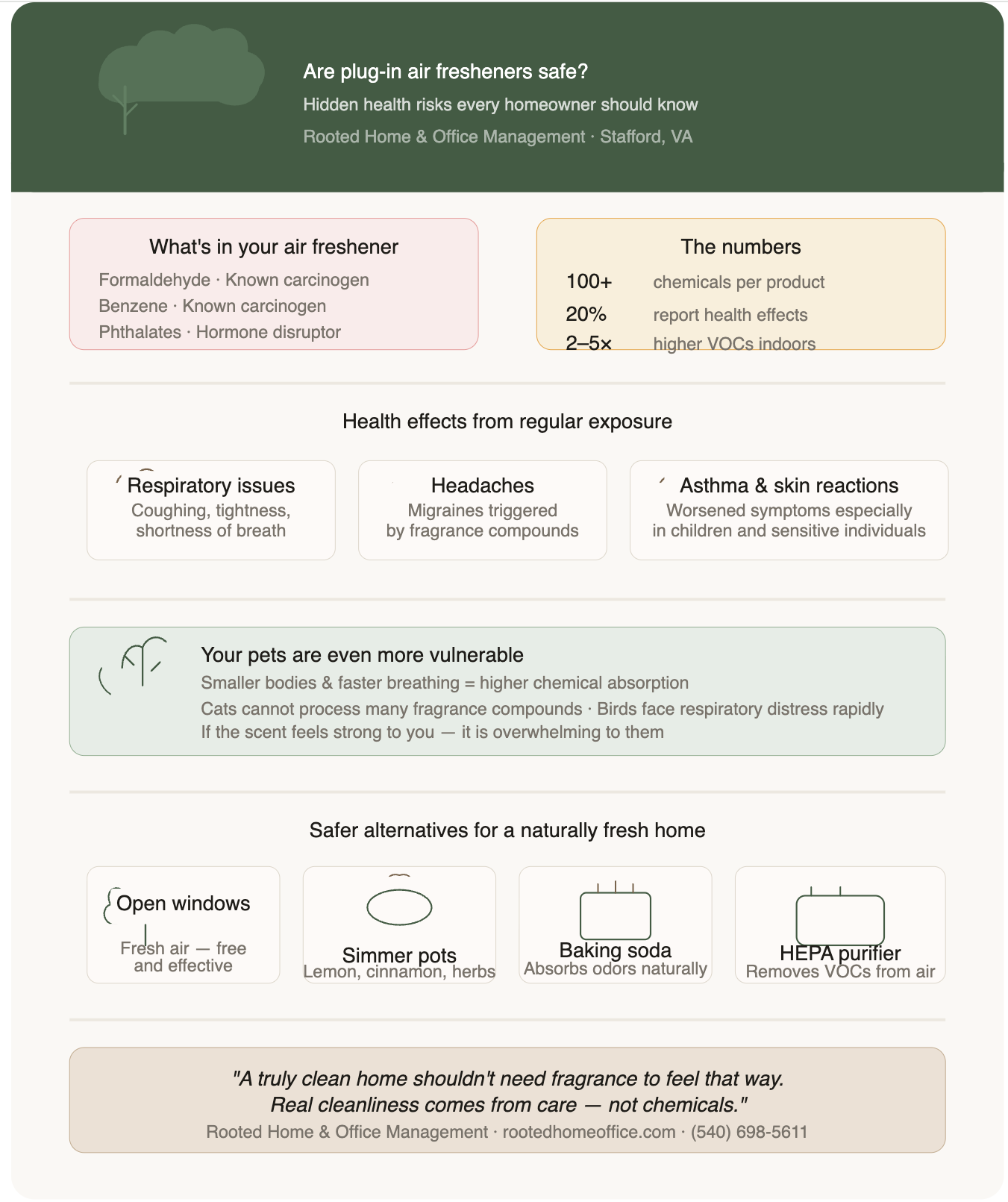
The dangers of air freshners…
That plug-in air freshener making your home smell "clean" may be releasing dozens of invisible chemicals into your air — including some linked to hormone disruption and cancer. Here's what the research says, what's hiding in your labels, and what to do instead.
Are plug-in air fresheners safe? Hidden health risks every homeowner should know
That "clean scent" filling your home might not be as harmless as it smells. Here's what the research actually says.
"Do you not know that your body is a temple of the Holy Spirit within you? … So glorify God in your body." — 1 Corinthians 6:19–20
Walk into almost any home and you'll smell it within seconds — the signature scent of a plug-in air freshener, a scented candle, or a spritz of something that's supposed to make the house feel fresh and clean. These products are everywhere, and for good reason. We want our homes to smell inviting. We want guests to notice a pleasant scent when they walk in. We want our spaces to feel cared for.
But here's something that might change how you look at that little plug-in on your wall: the "clean scent" it's releasing into your air is often made up of dozens of invisible chemical compounds — and growing research suggests that some of them may be affecting your lungs, your hormones, and your long-term health in ways most people have never been told about.
This isn't about fear. It's about awareness. And awareness is where better choices begin.
"A home that smells clean and a home that is clean are not always the same thing."
What's actually inside plug-ins and scented products
Most commercial air fresheners — including plug-ins, aerosol sprays, scented candles, and wax melts — work by releasing volatile organic compounds, or VOCs, into the air. VOCs are carbon-based chemicals that evaporate at room temperature and are inhaled directly into your respiratory system.
Studies have found that a single air freshener product can emit dozens — and in some cases over 100 — different chemical compounds into your indoor air. Some of the most commonly identified include:
Formaldehyde
Released by many fragranced products, particularly when heated or burned
Known carcinogenBenzene
A byproduct of burning scented candles and some plug-in formulas
Known carcinogenPhthalates
Used to carry and extend fragrance; often unlisted on labels
Endocrine disruptorToluene
A solvent found in many synthetic fragrance blends
Respiratory irritantWhat makes this especially concerning is that these compounds don't just linger in the air — they can also react with other compounds in your home to create secondary pollutants. That means what you're actually breathing isn't just the product itself. It's the result of a chemical reaction happening invisibly inside your living space.
The cancer and hormone disruption concern
Of all the compounds found in air fresheners, two categories draw the most concern from researchers and health professionals.
Phthalates are chemicals used to stabilize and carry fragrance, helping scents last longer. They're classified as endocrine disruptors — meaning they interfere with your body's hormonal system. Research has linked phthalate exposure to reproductive issues, developmental concerns in children, and disruptions to thyroid function. What makes them particularly problematic is that companies are not legally required to list phthalates on product labels. They can appear under the blanket term "fragrance" — and you'd never know.
Formaldehyde and benzene, both classified as known or suspected carcinogens, can be released when fragranced products are heated or burned. Scented candles are a particularly common source. Studies have found that burning paraffin candles — the most widely sold type — can release detectable levels of both compounds into indoor air.
What the research shows
One study found that 20% of people reported health problems they could directly attribute to air freshener exposure — including headaches, migraines, respiratory irritation, and asthma attacks. These effects were reported even with short-term exposure in sensitive individuals.
Real health effects people experience
The research on fragranced products points to a range of health effects, particularly with regular, long-term exposure in enclosed spaces. These include:
- Respiratory irritation — coughing, tightness, shortness of breath
- Headaches and migraines triggered by fragrance compounds
- Asthma attacks and worsened asthma symptoms, especially in children
- Skin reactions and contact dermatitis from fragrance chemicals
- Neurological symptoms including dizziness, brain fog, and difficulty concentrating
"A prudent person foresees danger and takes precautions. The simpleton goes blindly on and suffers the consequences." — Proverbs 27:12
What about your pets? This part matters
Your pets are even more vulnerable than you are
Because of their smaller bodies, faster breathing rates, and constant exposure at floor level — right where plug-ins release their compounds — pets absorb a disproportionately high amount of what's in your air.
- Cats cannot metabolize many fragrance compounds — their livers lack the enzymes to process them
- Birds have extremely sensitive respiratory systems — fragranced products can cause respiratory distress very quickly
- Dogs spend most of their time at floor level, where VOC concentrations are often highest
If a scent feels strong to you, it is overwhelming to them. This is one of the most overlooked indoor air quality issues for pet-owning households — and one of the simplest to address.
The truth most people don't know about labels
Here's something that may genuinely surprise you: companies are not legally required to list every ingredient in a fragrance blend on their product label. The word "fragrance" — or "parfum," or "essential blend" — can legally represent dozens of undisclosed chemical compounds. It's a significant gap in consumer protection that researchers and advocacy groups have been pushing to close for years.
This means that when you see these words on a label, you may be getting far more than you bargained for:
"Fragrance"
Can represent 50–100+ undisclosed chemicals
"Natural"
No regulated definition — still may release VOCs
"Clean"
A marketing term — not a safety standard
"Eco-friendly"
Plant-derived ingredients can still irritate airways
Let's be honest about the risk level
What the science actually says
- Occasional, short-term exposure is unlikely to cause immediate harm in healthy adults
- Long-term, daily use in closed indoor spaces is where concern grows — this is what researchers are studying
- Children, elderly individuals, and those with asthma or respiratory conditions face higher sensitivity
- Pets — especially cats and birds — face significantly higher risk due to physiology and floor-level exposure
The goal here isn't to make you afraid of every candle. It's to give you information that most product marketing will never share — so you can make choices that genuinely serve your family's health.
Safer alternatives that actually work
You don't have to give up a home that smells welcoming. You just need smarter options that create freshness without the chemical trade-off.
Better choices for a naturally fresh home
Open windows
Fresh air is still the most effective — and free — air freshener available
Simmer pots
Lemon slices, cinnamon sticks, and fresh herbs simmered in water — naturally aromatic
Baking soda
Absorbs odors rather than masking them — place in bowls in problem areas
HEPA purifiers
Remove particulates, allergens, and VOCs from indoor air without adding chemicals
"A truly clean home shouldn't need fragrance to feel that way. Real cleanliness comes from removing what doesn't belong — not covering it."
What this means for how we clean your home
At Rooted Home & Office Management, we don't use heavily fragranced products to make your home smell clean after we leave. We believe a home should feel genuinely fresh — not because of what we've added to the air, but because of what we've removed from the surfaces, the corners, the vents, and the places where buildup quietly accumulates.
That's what real cleanliness is. It's not a scent. It's an environment. And it's what we work to create in every home and office we serve across Stafford, Fredericksburg, and Spotsylvania.
"My people are destroyed for lack of knowledge." — Hosea 4:6
Faith-based. Woman-owned. Community-focused.
At Rooted Home & Office Management, we believe a truly clean home is safe for your family, your pets, and your health. We bring care, knowledge, and faith-driven standards to every home and office we serve across Stafford, Fredericksburg, and Spotsylvania.
Ready for a home that's truly clean — not just scented?
If you've been relying on plug-ins to make your home feel fresh, it might be time for a real reset. Let us create an environment that's genuinely clean, naturally fresh, and safe for everyone in it.
(540) 698-5611 — call or text anytime